

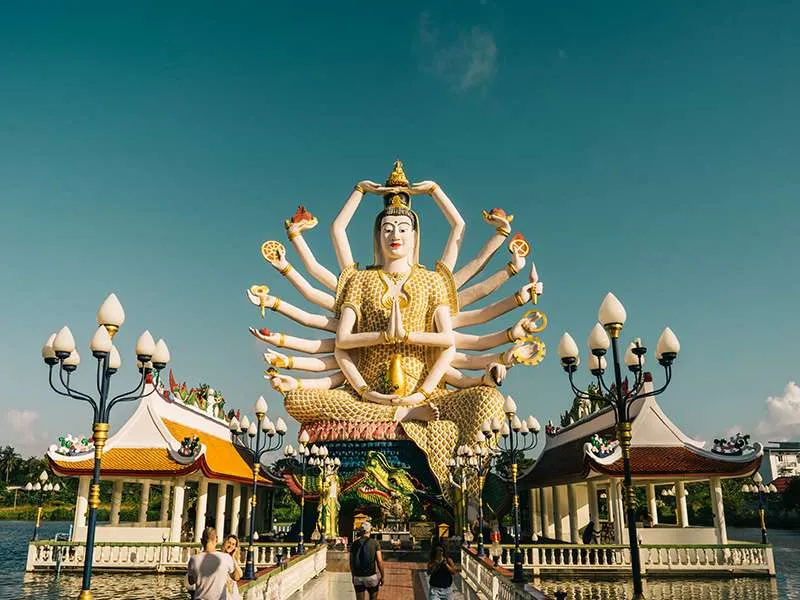
A few minutes from the Big Buddha, on Koh Samui’s north-east tip, Wat Plai Laem is one of the most photographed temples on the island. A white, many-armed goddess seems to rise out of a lake, a huge laughing Buddha grins from the opposite bank, and the water churns with fish the moment someone opens a bag of fish food. It is colourful and easy to visit, and it gives you a good first look at Samui’s mix of Thai and Chinese traditions.
Quick answer: It is a modern Thai-Chinese temple built around a lake. The centrepiece is a white, 18-armed statue of Guanyin, the bodhisattva of compassion, and there is also a large Laughing Buddha (Budai). Entry is free (donations welcome). It is reported to open roughly 6 AM–6 PM daily, but check locally. Cover shoulders and knees, take your shoes off before going into buildings and allow 30–45 minutes. If you want to feed the fish, buy fish food at the temple.
Quick facts
| Location | Plai Laem, on the north-east tip of Koh Samui, a few minutes’ drive from the Big Buddha |
| Built | A modern temple, reportedly built between 2004 and 2009 |
| Highlights | 18-armed Guanyin, Laughing Buddha (Budai), lakeside ordination hall, fish feeding |
| Entry | Free, donations welcome |
| Hours | Reported as roughly 6:00 AM–6:00 PM daily. Check locally |
| Dress code | Shoulders and knees covered, shoes off inside buildings |
| Time needed | About 30–45 minutes |
These details come from Thai Holiday Guide (reviewed July 2026) and Wikipedia.
The 18-armed Guanyin
The statue most people come for is not the Buddha. It is Guanyin (Kuan Im in Thai), the bodhisattva of compassion and mercy, much loved by Chinese and Thai-Chinese Buddhists. Here she takes a Chinese-style form with eighteen arms, a manifestation known as Cundi (Wikipedia: Wat Plai Laem).
In Chinese Buddhist art, each hand of the eighteen-armed form holds a different implement. Together they stand for the many skilful ways compassion can reach people (Wikipedia: Guanyin). Before you take your photo, have a look at what each hand is holding.
The statue stands in the open air within an elaborate ordination hall (ubosot), on a platform with the lake all around it. The temple’s design mixes Chinese and Thai traditions and was partly the work of the Thai artist Jarit Phumdonming.
Why a Chinese goddess on a Thai island?
Samui has deep Chinese roots. In the 19th century many traders from Hainan settled here and started the island’s coconut and cotton plantations, and several Hainanese temples and communities are still around (Wikipedia: Ko Samui). This lakeside temple shows that mix, with Thai temple architecture next to Chinese Mahayana imagery.
The Laughing Buddha
Across the lake sits a large, white, smiling figure with a big round belly. This is Budai, often called the Laughing Buddha. Despite the nickname, he is not Gautama Buddha. Budai is based on a Chinese monk whose cheerful nature made him a popular figure, and in the Chan (Zen) tradition he is seen as an incarnation of Maitreya, the future Buddha (Wikipedia: Budai). He stands for contentment and abundance, and many visitors rub his belly for luck.
Other shrines to look for
Around the grounds there are smaller shrines to Hindu deities, including Ganesha, Vishnu and Shiva, and to Sakka (Indra), king of the gods in Buddhist cosmology. Thai temples often mix Buddhist and Hindu figures like this. Keep an eye out for the decorative statues dotted around the site as well, elephant figures among them.
Feeding the fish
The temple lake is full of large fish, mostly carp, and feeding them is a way of making merit. Fish food is sold on site (Thai Holiday Guide). Some pointers before you start.
- Use the temple’s fish food, not bread or snacks brought from outside. They are bad for the fish and foul the water.
- Scatter small handfuls instead of tipping out the whole bag. The fish keep coming for longer that way.
- Keep the bag. Empty packets go in a bin, never in the lake.
- Hold on to small children. The fish surge to the surface in a big, splashing crowd, and excited children lean further over the water than you expect.
- Leave a small donation if you enjoyed it. Donations help keep the temple running.
Dress code and etiquette
People come here to worship, as well as to look around, so the usual temple rules apply.
- Cover shoulders and knees. Bring a sarong or scarf if you are coming straight from the beach.
- Take your shoes off before going into buildings.
- Don’t climb on statues or sit on altars and railings for photos.
- Keep your voice down near people who are praying, and don’t point your feet at images.
- Drones: don’t fly over worshippers. Thailand has its own drone registration rules, so check them before flying anywhere.
When to visit Wat Plai Laem and getting there
Early morning is cooler and quieter, and the white statues glow in the low sun. Late afternoon brings warm light over the lake. Midday is hot, and the walkways have little shade.
The temple is on the north-east tip of Samui, about five minutes from the Big Buddha and a short drive from Bophut, Choeng Mon and Chaweng. A taxi or scooter is the easiest way to get there. If you ride, wear a helmet. Thai law requires it.
Combine it with nearby sights
- Big Buddha (Wat Phra Yai) is a few minutes away and the obvious partner for a half-day of temples.
- Fisherman’s Village, Bophut has shops, cafés and seafront dinners. Friday, when the Walking Street runs, is the liveliest night.
- A rainy-day plan: both temples fit into a dry spell between showers. See our Koh Samui rainy day guide.
- Families: children love feeding the fish. There are more ideas in Koh Samui with kids.
For more temples, waterfalls and viewpoints, see our list of things to do in Koh Samui.
Seeing more of Samui’s temples
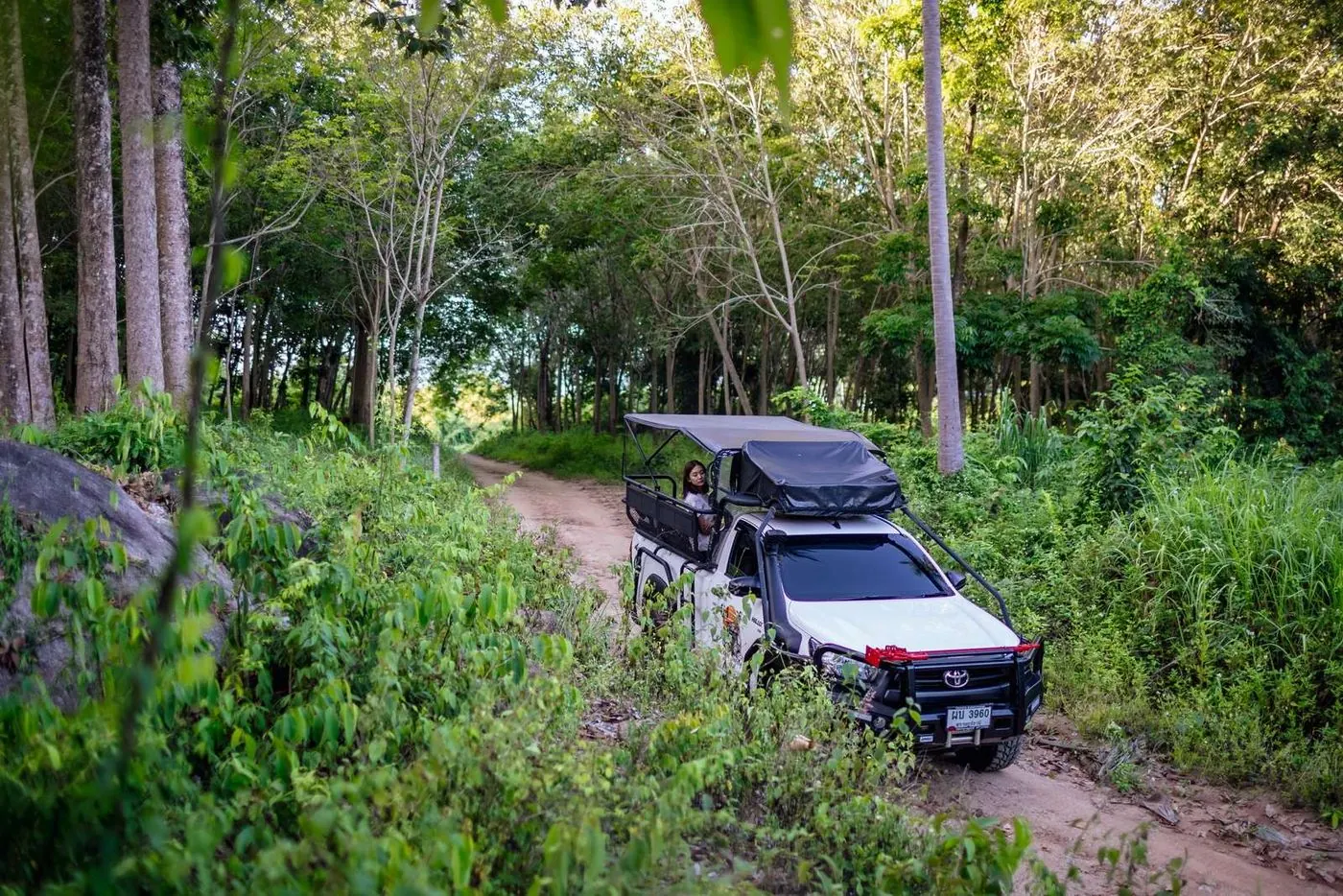
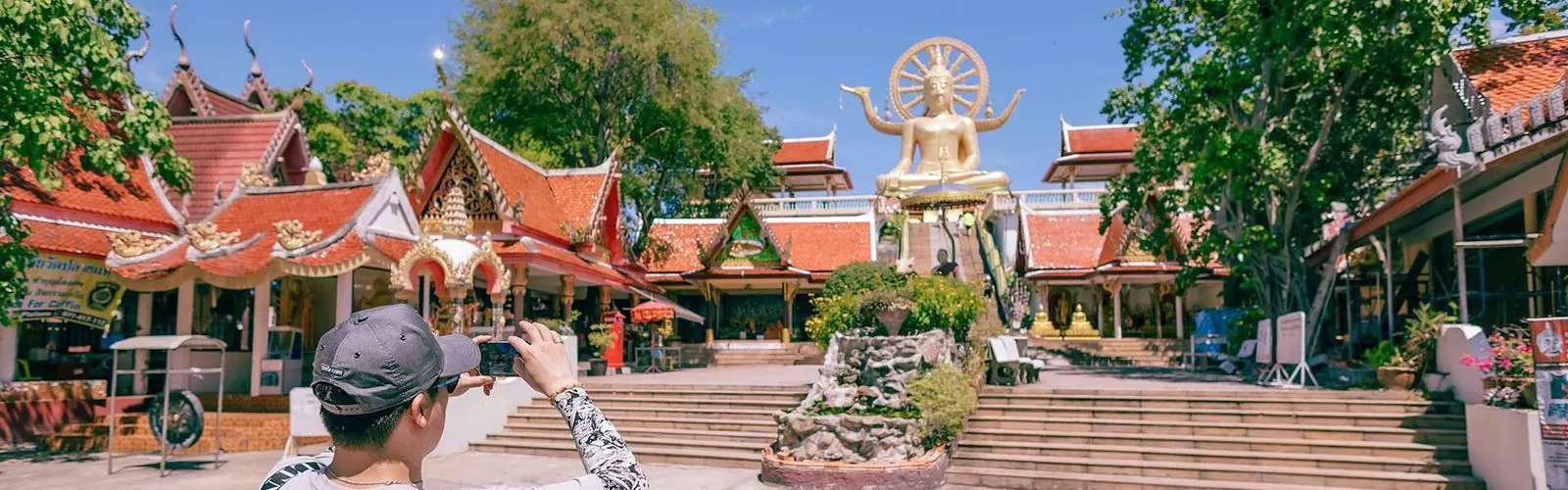
This temple is not a stop on our 4×4 day, but its neighbour the Big Buddha is. For a guided day of Samui’s culture and countryside, our Explore the Real Samui 4×4 Island Safari starts at the Big Buddha. It goes on to a village khanom ko workshop, Wat Sawang Arom with its murals and mummified monk, a durian orchard and the mountain-top Wat Teepangkorn, lunch with a view, Namuang Waterfall, rubber tapping and the Grandfather and Grandmother Rocks. A visit here takes under an hour, so it is easy to fit in on your own on another day.
Temples, villages and a waterfall in one day
Join the Explore the Real Samui 4×4 Island Safari, starting at the Big Buddha. Hotel transfers, guide, lunch and accident insurance are included. Adult (12+) from ฿1,950 · Child (5–11) ฿1,650 · Under 5 free. See the safari details or WhatsApp +66 94 751 4988.
FAQ
Is Wat Plai Laem free to visit?
Yes. Entry is free and donations are welcome. Bring a little cash for fish food.
Who is the statue with many arms?
Guanyin (Kuan Im), the bodhisattva of compassion, in an eighteen-armed form. Each hand holds a different object, standing for the many ways compassion reaches people.
Can you visit this temple and the Big Buddha together?
Yes. They are about five minutes apart by road, and most people see both in one morning or afternoon.
What should I wear to the temple?
Clothes that cover your shoulders and knees, and shoes you can slip off easily before going into buildings.
Is it good for children?
Yes, very. For most children, feeding the fish is the highlight. Keep a hand on little ones near the water’s edge.
 Plan your trip