

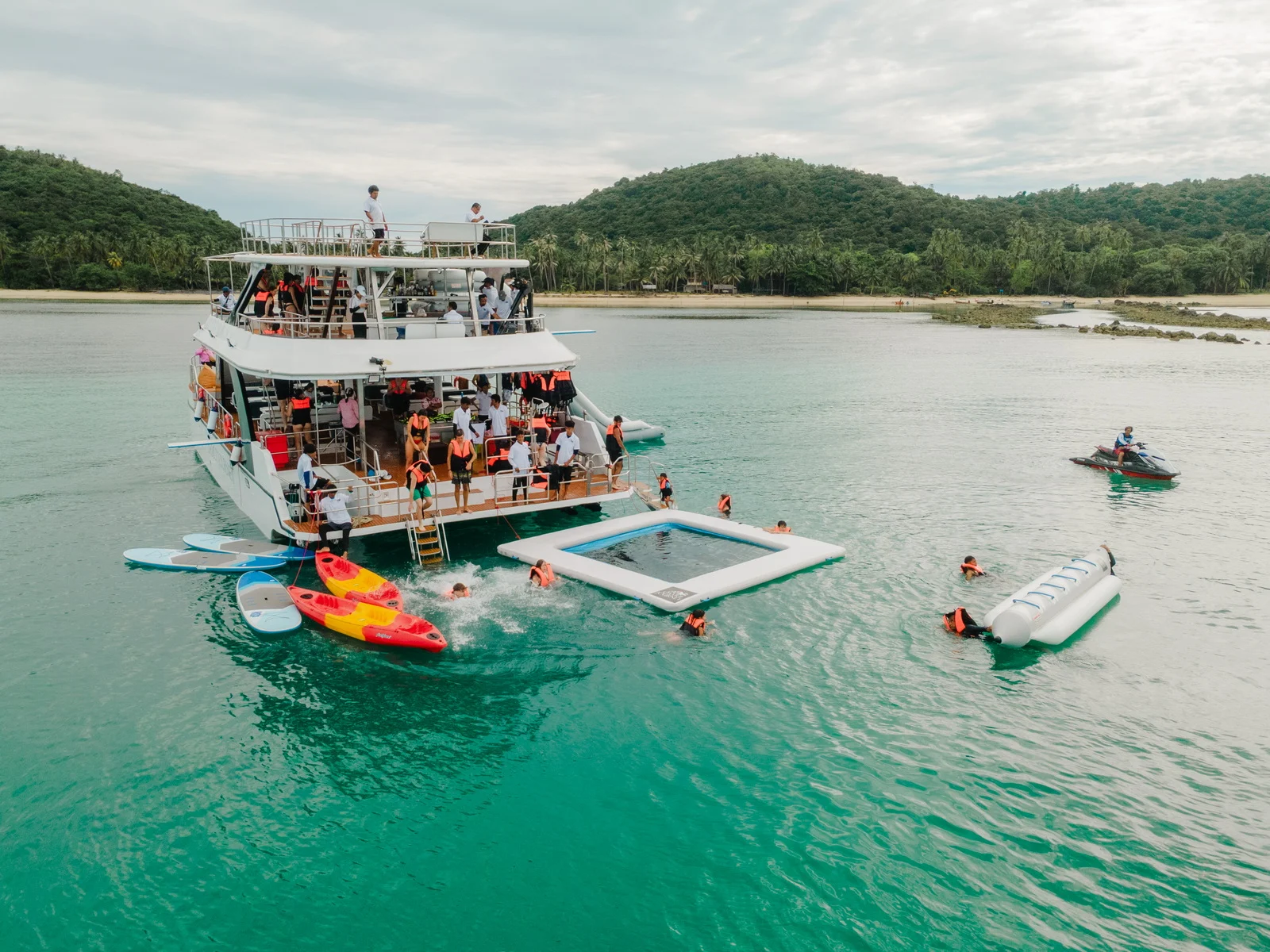
Koh Tan (also spelled Koh Taen) is where most Samui boat trips head when the plan is “get in the water”. It sits just off Samui’s south coast, with a fringing coral reef along its shoreline and a lot of shallow, sheltered water. That makes Koh Tan snorkeling one of the easiest starts near Samui for first-time snorkellers.
This page is about the snorkelling itself. It covers what the reef is like today, how to get comfortable with a mask and snorkel, how to stay safe, and how to avoid damaging the coral you came to see. If you have not yet decided where to snorkel, our round-up of the best snorkeling spots around Koh Samui compares boat trips and beach coves.
Quick facts
| Name | Koh Tan / Koh Taen (เกาะแตน) |
| Location | South of Koh Samui, Taling Ngam sub-district, Surat Thani province |
| Size | About 7.5 km², roughly 3 km wide and 4.5 km long |
| Highest point | A hill of just over 200 m, with a Buddha statue on top |
| Residents | A small community. Most of the island is natural forest, mangrove and beach |
| Snorkelling style | Shallow fringing reef close to shore, much of it a few metres deep |
| Visibility | Variable. Often best on calm days in the drier months, lower after wind or rain |
| Getting there | Longtail or speedboat from Thong Krut (about 20 minutes), or the Samui Journey catamaran from Bang Kao Pier (arrives about 11:50 AM) |
| Good for | Beginners, families, confident swimmers who want an easy reef |
About the island
Koh Tan is not a resort island. Thai sources describe a long-established fishing and coconut-farming community that once numbered around a hundred households. Many families left after a beetle infestation wiped out the coconut palms, and only a small population lives there today. Locally the island is known for an odd piece of folklore. It is said to have no dogs, and the explanations range from a guardian spirit to theories about underwater sound.
For snorkellers, two sides of the island matter.
- The east side (Ao Awk) has a long beach running parallel to a fringing coral reef.
- The west side (Ao Tok) is a more enclosed bay with mangroves, a rocky shoreline and coral.
Boat crews pick the spot on the day depending on wind and swell, so you may snorkel off either side.
What the reef is like
Go in with the right expectations and you will have a better day. Koh Tan has a shallow, near-shore reef, not a dramatic drop-off. Expect to float over patches of hard and soft coral, sand channels and rocks, with schools of small reef fish around them. Tour operators and visitors commonly report reef fish and giant clams, and now and then something larger such as a ray or barracuda.
Like reefs across the Gulf of Thailand, Koh Tan has been under pressure. During the 2024 coral bleaching event, caused by unusually warm seawater, the Gulf was the worst-hit part of Thailand, and shallow corals suffered most. Many bleached corals have recovered since, but not all survived. Thailand’s Department of Marine and Coastal Resources has also run underwater clean-ups here. In March 2023 one dive team pulled around 150 kg of debris off the reef at Koh Tan, mostly old fishing nets, rope and tubes. Some areas look healthier than others, which is why careful snorkelling matters.
How to visit
On the Samui Journey 1-Day Catamaran
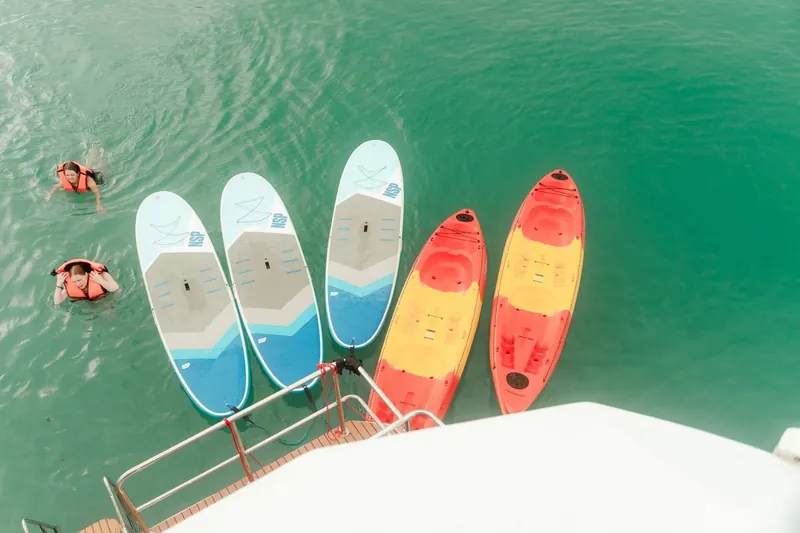
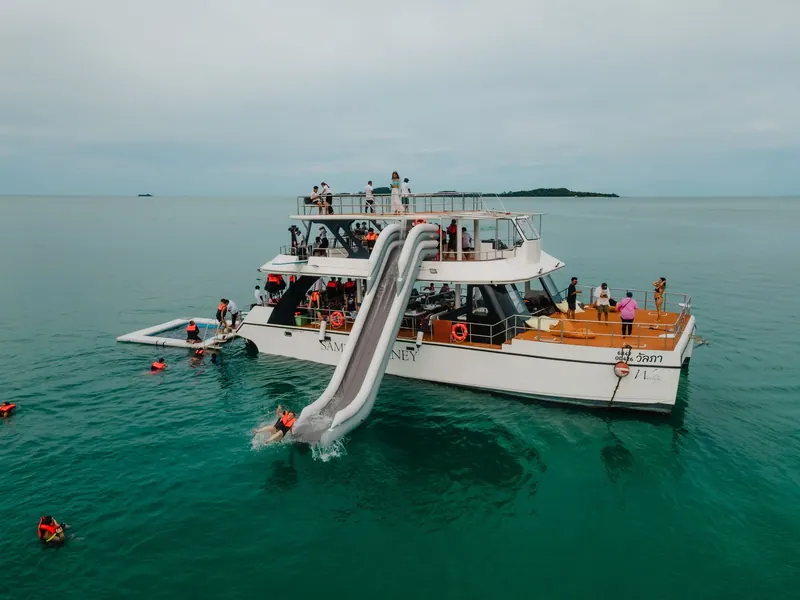
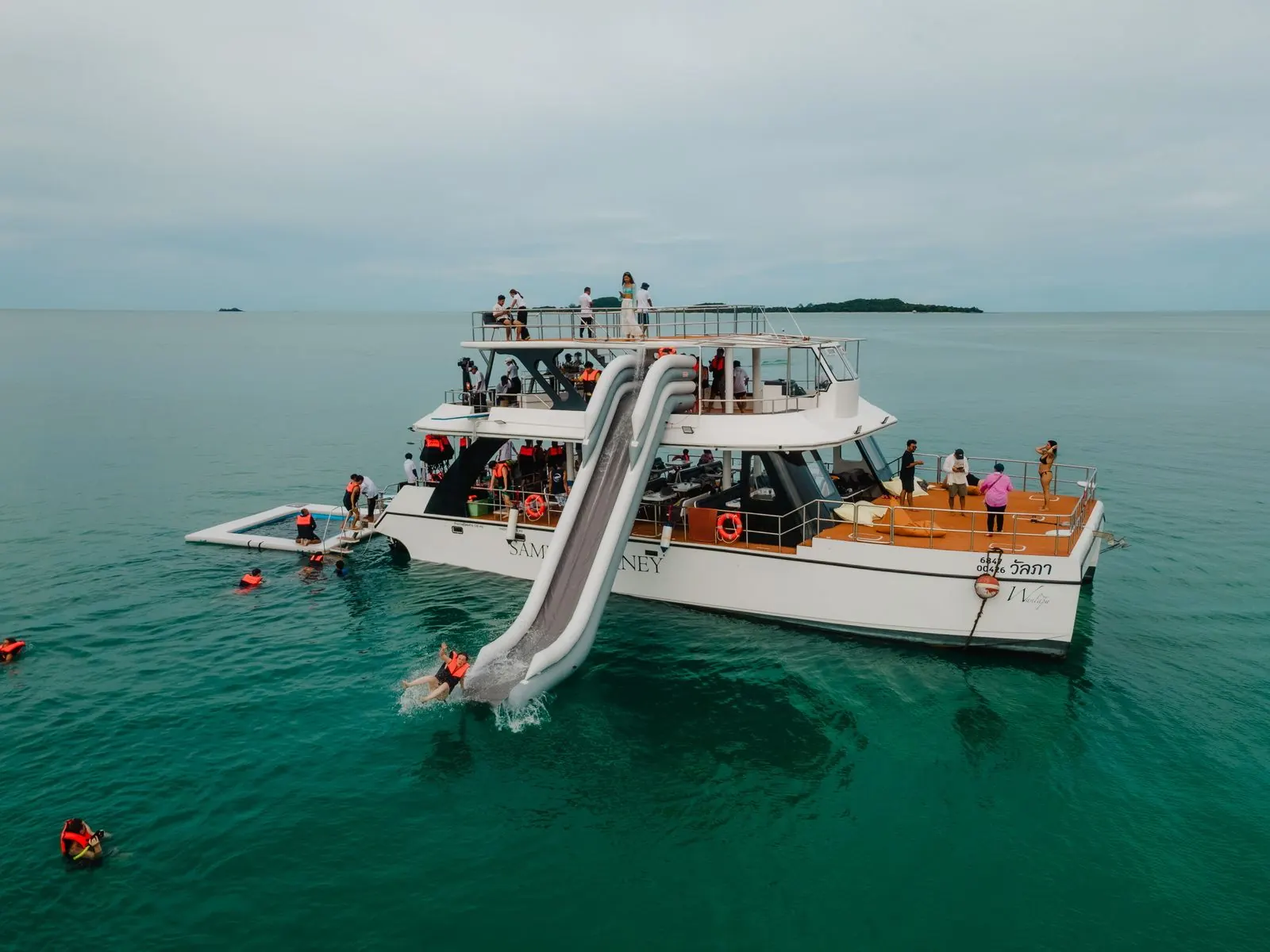
Koh Tan is the main activity stop of the day. After pickup (9:00–9:40 AM depending on area) and a sightseeing stop at the Five Islands, the catamaran arrives at Koh Tan around 11:50 AM. Snorkel gear and life jackets are included. If snorkelling is not for you, switch to paddleboarding, kayaking, the floating sea pool, the banana boat, the springboard or the water slide (all included in the price), or stay on deck with a free-flow cocktail, mocktail or soft drink. You can also have a Thai massage on board between swims. Lunch is served onboard at about 12:45 PM, and the afternoon ends at Pig Island.
For Koh Tan snorkeling, a big, stable boat helps. You can get in and out easily, rest onboard between swims and use the toilet without going ashore.
Snorkel Koh Tan with everything included.
Gear, life jackets, English- and Chinese-speaking guides, lunch and drinks are covered on our 1-Day Catamaran. Adults ฿3,300, children (5–11) ฿1,900, under 5s free. Check availability or WhatsApp +66 94 751 4988.
Independently from Thong Krut
Longtail boats leave from Thong Krut on Samui’s south-west coast, about 20 minutes from Koh Tan. Agree the price, the time on the water and which islands are included before you go. Check any rental masks too. Nothing spoils a snorkel faster than a mask that leaks.
Koh Tan snorkeling technique for first-timers
1. Fit the mask properly
Hold the mask against your face without the strap and breathe in gently through your nose. If it stays put, it fits. Then set the strap above your ears. Not too tight, or it will leak and leave marks. Push hair out of the seal, because a long fringe is the most common cause of leaks.
2. Stop it fogging
Use anti-fog spray if you have it. If not, rub a tiny drop of baby shampoo on the inside of the lens and rinse it in seawater. That works well. Rinse the mask in the sea just before you put it on.
3. Practise breathing at the surface
Before you swim off, float next to the boat with your face in the water and breathe slowly and deeply through your mouth. Short, panicky breaths make you feel short of air. Most beginners settle down after a minute.
4. Clear the snorkel
If water gets in, blow it out of the top with one short, sharp exhale, as if saying “too”. Then breathe in carefully. If it is still wet, lift your head and empty it.
5. Wear the life jacket
A life jacket holds you at the surface without any effort, which is what you want over a shallow reef. It also stops you sinking onto the coral. On the catamaran there are life jackets for everyone.
6. Move slowly
Fish come closer when you are calm. Kick gently from the hips, keep your hands still or clasped, and look down and around instead of chasing.
Reef etiquette: snorkel without leaving a mark
- Do not stand on the coral. If you need a rest, float on your back or go back to the boat. Coral is a living animal and breaks easily.
- Do not touch or collect anything. That means shells, coral and sea urchins (which hurt, too).
- Do not feed the fish. It changes how they behave and harms the reef ecosystem.
- Use reef-safe sunscreen, or cover up. In 2021 Thailand’s national park authority banned sunscreens containing oxybenzone, octinoxate, 4-MBC and butylparaben from its marine national parks. Outside park boundaries too, a rash vest or long-sleeved swim top is better for the reef, and for your skin.
- Keep your fins and feet up over shallow coral.
- Take rubbish back with you, down to small things like bottle caps.
Safety
- Swim with a buddy and stay where you can see the boat or your guide.
- Watch for boat traffic. Stay in the area your crew points out, and never swim into channels used by longtails or speedboats.
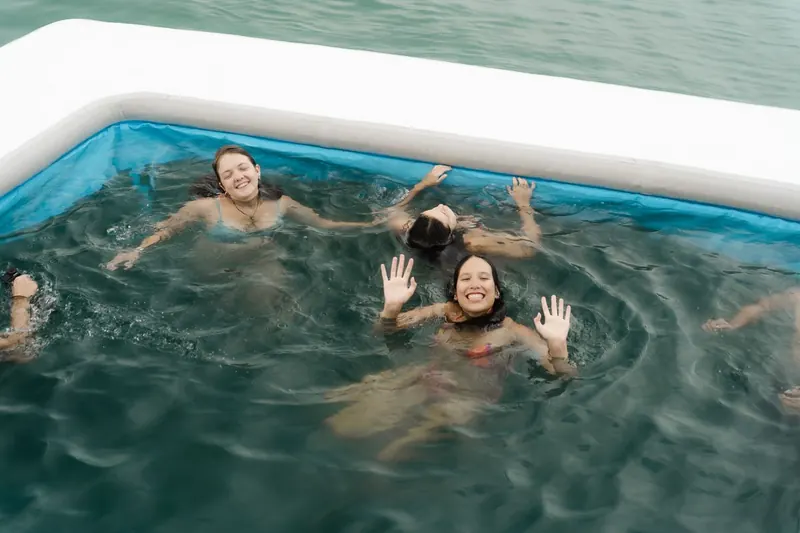
- Know your limits. Weak swimmers should stay close to the boat in a life jacket, or try the floating sea pool first.
- Jellyfish can turn up in Thai waters. If you are stung, get out of the water and tell the crew straight away. The catamaran carries a first-aid kit.
- Drink water. Snorkelling in the sun tires you out more than you notice. Drinking water is included onboard.
- Children should always wear a life jacket and have an adult with them in the water.
When to go snorkelling at Koh Tan
Koh Samui’s heaviest rain usually falls between mid-October and early December, when wind can churn up the sea and cut visibility. The drier months generally give clearer water, though it varies from day to day. The Gulf stays warm all year, so most people snorkel comfortably without a wetsuit.
If conditions are unsafe, Samui Journey moves you to another date free of charge, with a full refund if the new date is also affected.
What to bring
- Swimwear worn under your clothes
- Rash vest or long-sleeved swim top
- Reef-safe sunscreen (put it on 20–30 minutes before swimming)
- Your own mask if you wear prescription lenses or have one you like. Gear is provided, but nothing beats a mask that already fits you
- Anti-fog spray
- Waterproof phone pouch or action camera with a wrist strap
- Towel, hat and a dry change of clothes
- Seasickness tablets if you need them, taken before departure
Good to know
- No experience needed. Koh Tan snorkeling suits beginners, and you do not need scuba certification.
- Non-swimmers can still join in with a life jacket, in the floating sea pool, or by staying onboard.
- Visibility depends on the weather. Even in a good month, one windy night can cloud the water by morning.
- Plan the next day. After a full day in the water, a slower morning on land works well, for example the 3-hour programme at Samui Elephant Kingdom. If you liked paddling at Koh Tan, have a look at our kayaking destination page.
Make your Koh Tan swim part of a bigger day.
Five Islands in the morning, Koh Tan snorkeling and water toys at midday, Pig Island in the afternoon, back at your hotel around 4:30 PM. View the full itinerary. Free cancellation up to 24 hours before pickup.
FAQ
Is Koh Tan good for snorkelling?
Yes, especially for beginners. It has a shallow fringing reef close to shore and the water is generally sheltered. Expect a relaxed reef snorkel, not the deeper, clearer sites of dive destinations such as Koh Tao.
How deep is the water at Koh Tan?
Shallow. Much of the snorkelling area is often just a few metres deep, which is why it suits first-timers. Depth varies with the spot and the tide, so follow your crew’s guidance.
Do I need to be a strong swimmer?
No. A life jacket keeps you afloat without effort. You should be comfortable in the water, and weak swimmers should stay close to the boat.
Is snorkel gear included on the catamaran?
Yes. The Samui Journey 1-Day Catamaran includes snorkel gear and life jackets, plus paddleboards, kayaks, a floating sea pool and other water activities, all included in the price.
Can children snorkel at Koh Tan?
Yes, with a life jacket and an adult close by. Many children start in the floating sea pool before trying the open water.
What is the best time of year to snorkel at Koh Tan?
On calm days in the drier months, outside the mid-October to early December rainy peak. Visibility always depends on recent wind and rain.
How far is Koh Tan from Koh Samui?
About 20 minutes by longtail from Thong Krut, just off Samui’s south coast. On the catamaran it is the second stop, reached around 11:50 AM.

 Islands & boats
 Islands & boats