

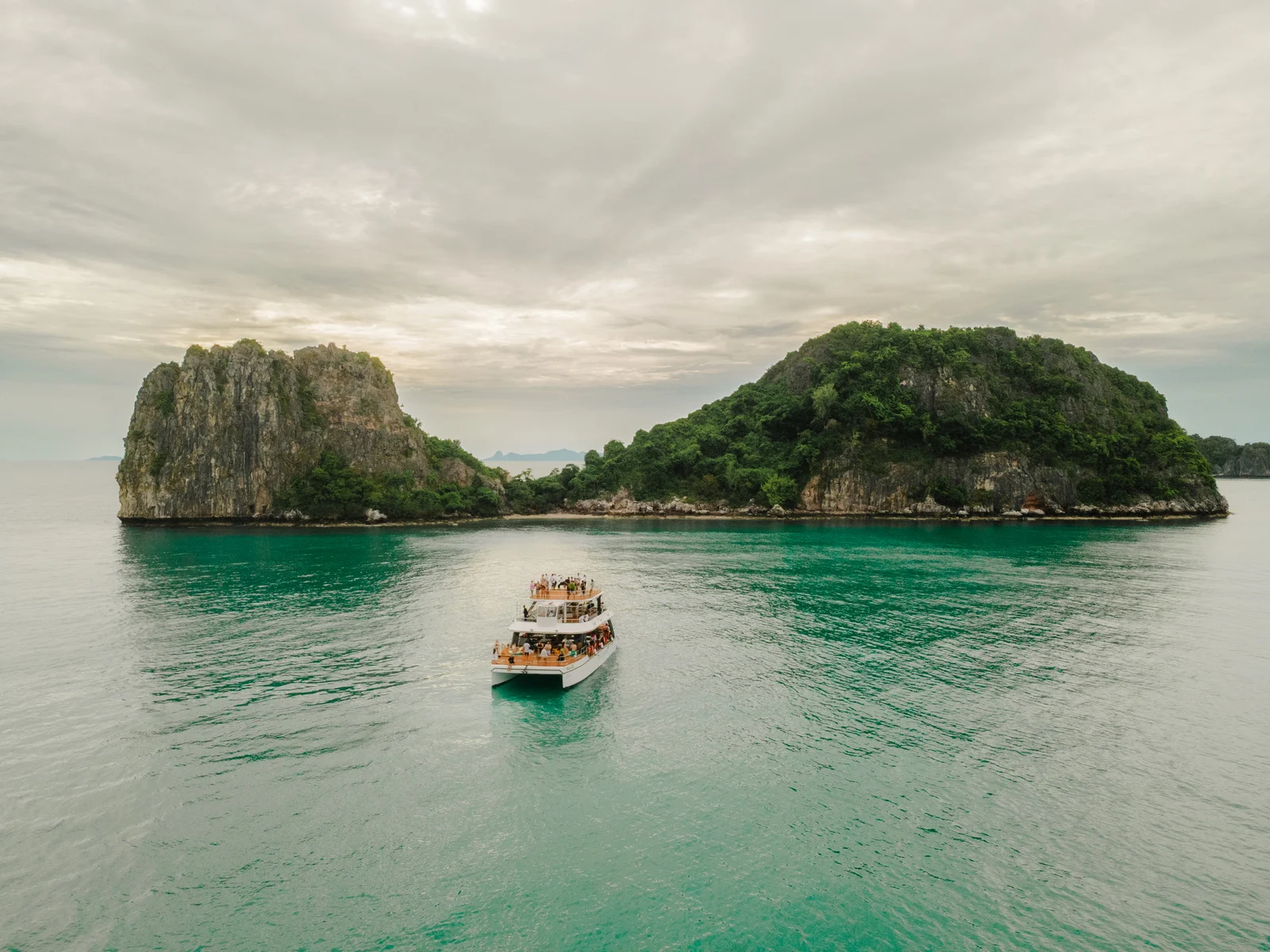
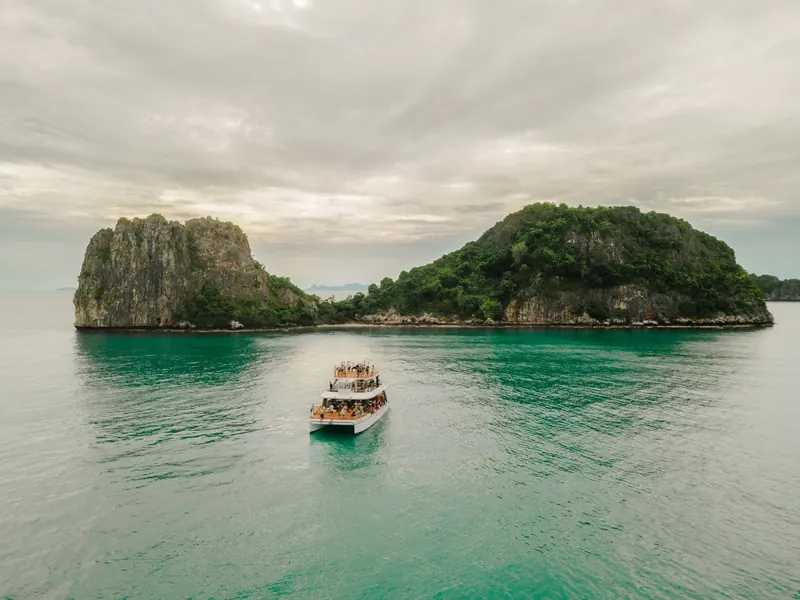
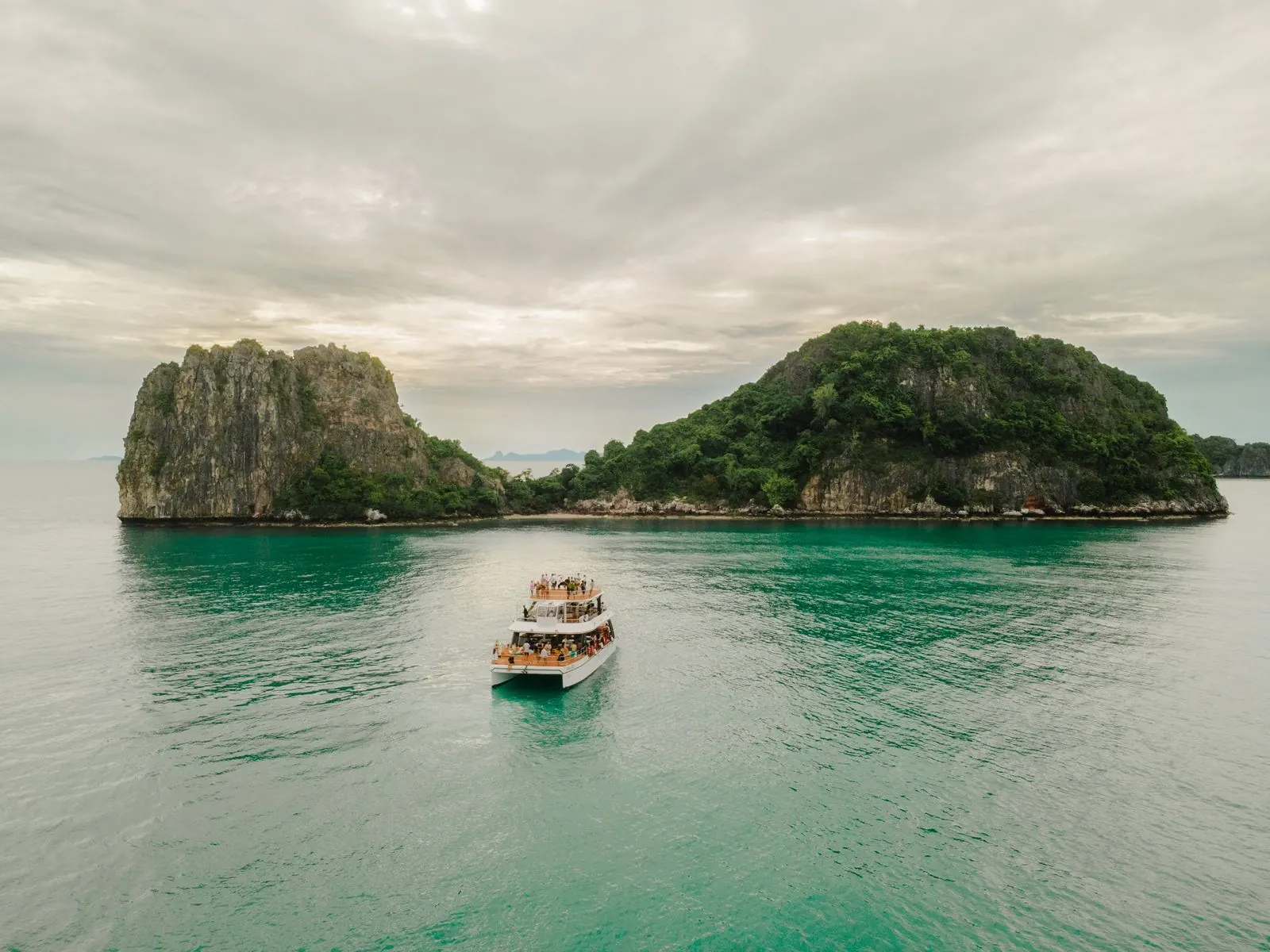
Sail south-west from Bang Kao Pier and the first big sight of the day is a cluster of sheer limestone rocks off the Taling Ngam coast. These are the Five Islands, or Koh Si Koh Ha. From the deck they look like scenery, but they are a working site, and the reason is a small, fast bird that builds its nest out of its own saliva.
Quick answer: The Five Islands off Koh Samui are limestone islets where edible-nest swiftlets breed in caves and cracks in the cliffs. Their nests, made almost entirely of hardened saliva, are the “bird’s nest” in bird’s nest soup and can sell for thousands of dollars a kilo. In Thailand only licensed collectors may take them, so the islands are guarded and visitors see them from the boat. Nobody lands.
This page is about the Five Islands bird nest story itself, meaning the bird, the nest, a trade that goes back centuries and the rules that protect it. For the practical side of the stop (where the islands are, photo tips and how the visit fits into a boat day), see our main Five Islands Koh Samui guide.
Quick facts
| The bird | Edible-nest swiftlet (Aerodramus fuciphagus), about 14 cm long and 15–18 g |
| The nest | Layers of hardened saliva stuck to the rock, roughly 6 cm across |
| Why it matters | Prized in Chinese cooking for centuries; white nests can fetch up to about US$2,800 per kg |
| Who may collect | Only people licensed under Thailand’s bird’s-nest duty law; collecting nests is otherwise illegal |
| Can visitors land? | No. The islands are guarded and seen from the water |
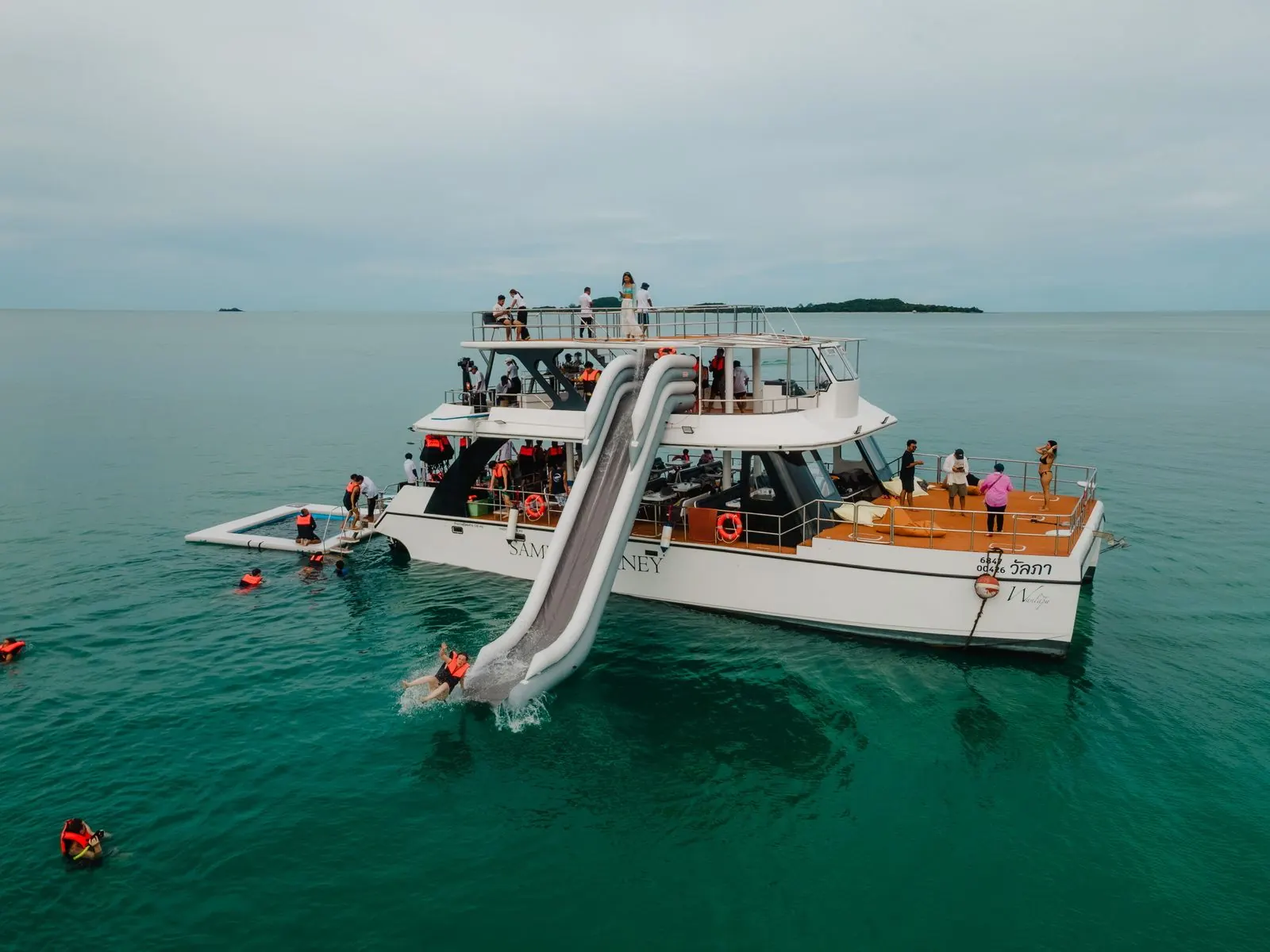
| How to see them | From a boat trip along Samui’s south-west coast, such as the Samui Journey 1-Day Catamaran |
Meet the swiftlet
Swiftlets look like swallows but belong to the swift family. The edible-nest swiftlet is a small brown-black bird of about 14 cm that spends its day on the wing, catching insects over the sea and forest. You find it across Southeast Asia, from the Andaman coast to Borneo and the Philippines (Wikipedia: edible-nest swiftlet).
Its party trick is echolocation. Like bats, swiftlets of the genus Aerodramus find their way through pitch-dark caves using clicks. Unlike most bat calls, these clicks sit well within human hearing, usually as a quick double click repeated in flight (Wikipedia: swiftlet). That lets them nest deep inside caves and fissures where predators struggle to follow, and that is the kind of rock you see at the Five Islands.
The species as a whole is listed as Least Concern. Some heavily harvested populations have still declined badly, such as those in India’s Andaman and Nicobar Islands, so how a colony is managed matters.
A nest made of spit
Most birds build with twigs, grass or mud. The edible-nest swiftlet uses saliva. In the breeding season, glands under its tongue swell and produce long, sticky strands, which the bird lays down in loops on a rock face. The strands harden in the air into a small, shallow cup glued to the wall.
- Size: about 6 cm across and 1.5 cm deep, and roughly 14 g in weight.
- Content: Thai sources put nests at around 85–90% saliva, with a small share of feathers.
- Purpose: the cup holds the eggs, then the chicks until they can fly.
Thai traders sort nests into types. “Island nests” (rang nok koh) from natural cliffs and caves are generally rated the best in Thailand. “House nests” come from purpose-built swiftlet houses, now common in southern Thai towns such as Pak Phanang. Black nests have more feathers in them and cost less, and red nests take their colour from minerals in the cave rock (Thai Wikipedia: edible bird’s nest).
Why bird’s nest is worth so much
People have eaten bird’s nest as a delicacy for more than 400 years, mostly simmered with rock sugar as a sweet soup. Traditional Chinese medicine links it with good skin, healthy lungs and recovery after illness or childbirth. These are traditional beliefs, not established medical facts, but they keep demand high across East and Southeast Asia.
The money involved is large. White nests can sell for up to about US$2,800 per kilogram, and rare red nests for far more. Thailand produces an estimated 400 tonnes a year, in a trade worth around 20 billion baht annually (Wikipedia: edible bird’s nest). One cliff with a healthy colony can be worth a lot, which is why it has guards.
A trade with a royal history
Bird’s nest has been part of Siam’s economy for centuries. Before the trade treaties with Western powers in the 1850s, it was on a short list of goods, with sappanwood, tin, pepper and ivory, that foreign merchants could buy only through the royal warehouse and not from ordinary traders (Thai Wikipedia: 1856 US–Siam treaty).
The right to collect nests was often farmed out to a tax collector, or nai akorn. One well-known case shares a name with Samui’s islands. In the late 18th century, the founder of Songkhla’s na Songkhla family held the bird’s-nest concession for Ko Si Ko Ha in Songkhla Lake, a different limestone group far to the south in Phatthalung province (Thai Wikipedia: Ko Si Ko Ha). Search for “Koh Si Koh Ha” in Thai and many results are about that site, not Samui’s.
The name works the same way in both places. From some angles you count four peaks, from others five.
How Five Islands bird nest collecting works today
Licensed, not open to anyone
Under Thai wildlife law it is an offence to collect, damage or possess the nests of protected wild animals. The same section makes one specific exception, for people licensed under the law on bird’s-nest duty and those working on their behalf (Wild Animal Reservation and Protection Act 1992, section 21). Nest islands are run as concessions, and the concession holder posts guards. So boats keep their distance, and landing is not an option.
The harvest rhythm
Thai sources describe up to three collections a year from island colonies. The first, in late January or early February, takes the season’s first nests, which are thought to be the best. A second round comes around mid-March. The birds then rebuild and lay eggs, and the last collection waits until the chicks have grown and left, around July. Exact timing varies by site and is up to the licence holder. We do not publish harvest dates for the Five Islands bird nest colonies off Samui.
The size of the harvest depends directly on how many birds there are, so a well-run concession has every reason to protect the colony and the plants on the island. Over-harvesting, especially taking nests before the eggs hatch, is what has damaged colonies elsewhere.
What to look for from the boat
- Cave mouths and dark cracks high on the cliffs. Swiftlets pick these shaded, sheltered spots.
- Small, fast birds flicking in and out of the rock. Swiftlets fly on stiff, crescent-shaped wings and rarely seem to flap slowly.
- The “four becomes five” moment as the boat changes angle and the hidden islet comes into view.
- Listen when the engines go quiet. Swiftlet clicks are audible to people, so you may hear birds near the rock.
The nesting areas are high up, so binoculars or a phone with 3–5x zoom help a lot. Our boat trip packing checklist covers the rest.
Visiting responsibly
- Stay on the boat. The islands are private concession sites and a wildlife habitat.
- No drones near the cliffs. Flying close to nesting birds can disturb them, and Thailand has its own drone registration rules.
- Keep the noise down while the boat is close. The birds are easier to watch and hear that way.
- Take all rubbish home. Anything that blows overboard ends up on the rocks or the reef.
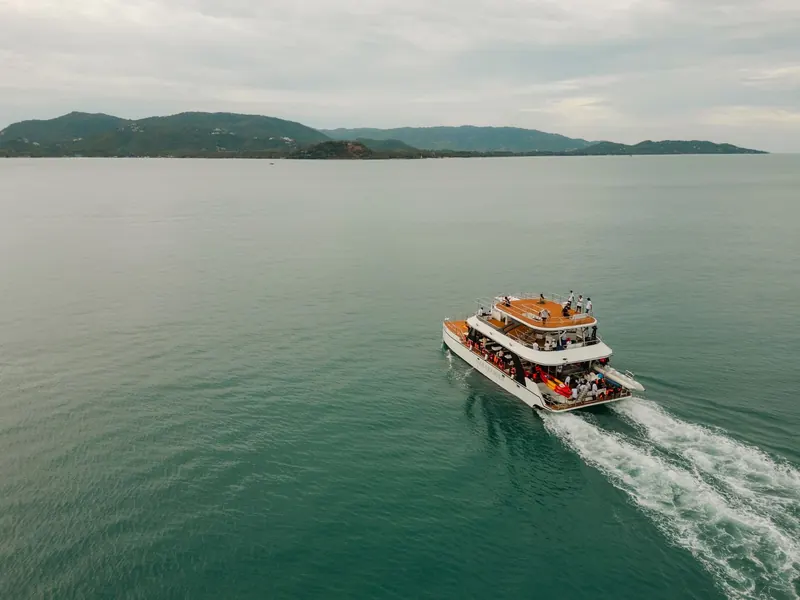
After the cliffs, most boat days go on to a swimming stop. On ours, that means snorkelling at Koh Tan (see our Koh Tan snorkelling guide) and then the beach at Pig Island (Koh Madsum). Still comparing options? Our guide to Koh Samui boat trips sets out the main types side by side.
See the swiftlet cliffs, then swim at Koh Tan.
The Samui Journey 1-Day Catamaran sails from Bang Kao Pier to the Five Islands, Koh Tan for snorkelling, and Pig Island. Hotel pickup from about 9:00–9:40 AM (by area), back at your hotel around 4:30 PM, with lunch, drinks, accident insurance and transfers included. Adults (12+) ฿3,300, children (5–11) ฿1,900, under-5s free. Free cancellation up to 24 hours before pickup. Check availability or WhatsApp +66 94 751 4988.
FAQ
Why can’t you land on the Five Islands?
Because they are a licensed bird’s-nest concession. Collecting nests without a licence is illegal under Thai wildlife law, and the concession holder guards the islands. Tourist boats see the cliffs from the water.
What is bird’s nest soup made of?
The cleaned nest of an edible-nest swiftlet, which is mostly hardened saliva. It is usually soaked, picked clean of feathers and simmered, often with rock sugar.
Are swiftlets the same as swallows?
No. They look alike, but swiftlets are in the swift family. The swallows you see on power lines build with mud and grass, while edible-nest swiftlets build with saliva.
Does nest harvesting harm the birds?
It depends on how it is managed. Taking nests too often, before the eggs hatch, has caused declines in some places. Well-run concessions time collections around the breeding cycle because their income depends on a healthy colony.
Is Koh Si Koh Ha in Samui the same as the one in Songkhla Lake?
No. They share a name and a trade, but the Songkhla Lake group is in Phatthalung province, far to the south. Samui’s Five Islands are a small group out in the open Gulf off Taling Ngam.
 Islands & boats