

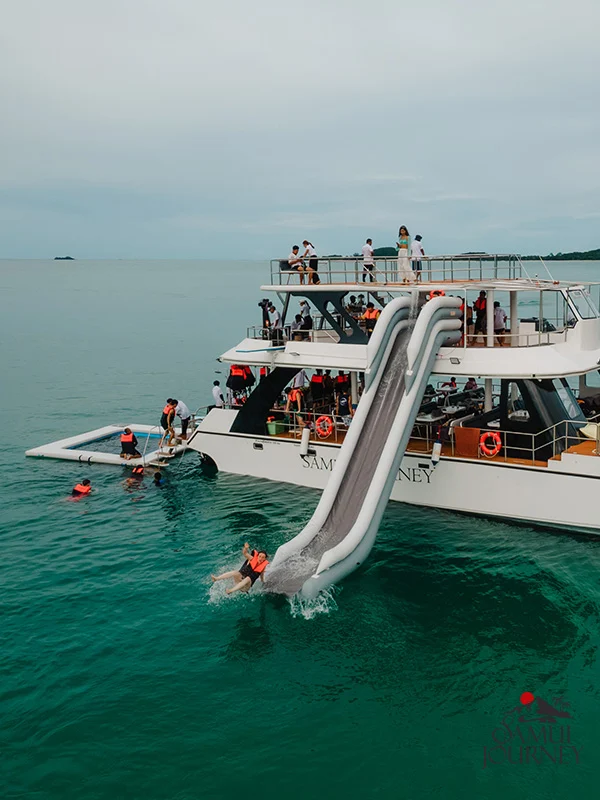
If you have ever had seasickness on a boat trip, choose your Koh Samui island day with care. Seasickness is often predictable. The type of boat, the route, the season and where you sit all make a difference. Below we compare a catamaran with a speedboat, sum up what reputable health sources advise, and list what you can do to give yourself the best chance of a good day.
| Quick answer | If you are prone to seasickness, pick a larger, steadier boat on a short route, go in the calmer months, sit in the middle of the boat, watch the horizon, and avoid alcohol and heavy meals beforehand. A catamaran generally moves more gently than a small speedboat, but no boat is motion-free. |
| Medicines | Ask a pharmacist or doctor before you travel. Most remedies work best taken before you set off, and some are not suitable for children |
| Calmest months | Usually February to April; November tends to be the roughest |
This page is general information, not medical advice. If you have a health condition, are pregnant or take other medication, check with a doctor or pharmacist before using any seasickness remedy.
Why seasickness happens
The NHS explains motion sickness as a clash of signals. Your inner ear feels the boat moving, while your eyes, fixed on the deck or a phone, tell your brain you are still. That mismatch can bring on dizziness, nausea, sweating, headache and vomiting.
Some people get it worse than others. According to the CDC Yellow Book, susceptibility is partly inherited and peaks in children aged about 7 to 12. Women are somewhat more susceptible than men, and people with a history of migraine are at higher risk. Lack of sleep and alcohol make it worse. The body can also get used to motion over time (habituation, or finding your “sea legs”), though this can take a while.
Catamaran vs speedboat: how they move
Every boat moves differently and every sea is different, so read the comparison below as a general guide, not a promise.
| Catamaran | Speedboat | |
|---|---|---|
| Hull | Two hulls set apart, giving a wide, stable base | Single hull, built for speed |
| Typical motion | Generally less side-to-side rolling, and a slower, steadier ride | Fast and bouncy in choppy water, with jolts as it hits waves |
| Time between stops | Longer, at a gentler pace | Shorter, at a faster pace |
| Space to move | Usually room to stand up, move to the middle or find shade | Often seated for the whole crossing |
| Spray | Usually drier | Expect to get wet in a chop |
| Best for | People prone to seasickness, families and mixed groups | Travellers who want to cover more ground quickly on a calm day |
A speedboat’s big advantage is short crossings. On a flat sea, a lot of people who dislike boats cope well with a quick run between islands. When it is choppy, a small, fast boat is far more likely to make sensitive passengers ill, and there is little room to move somewhere better.
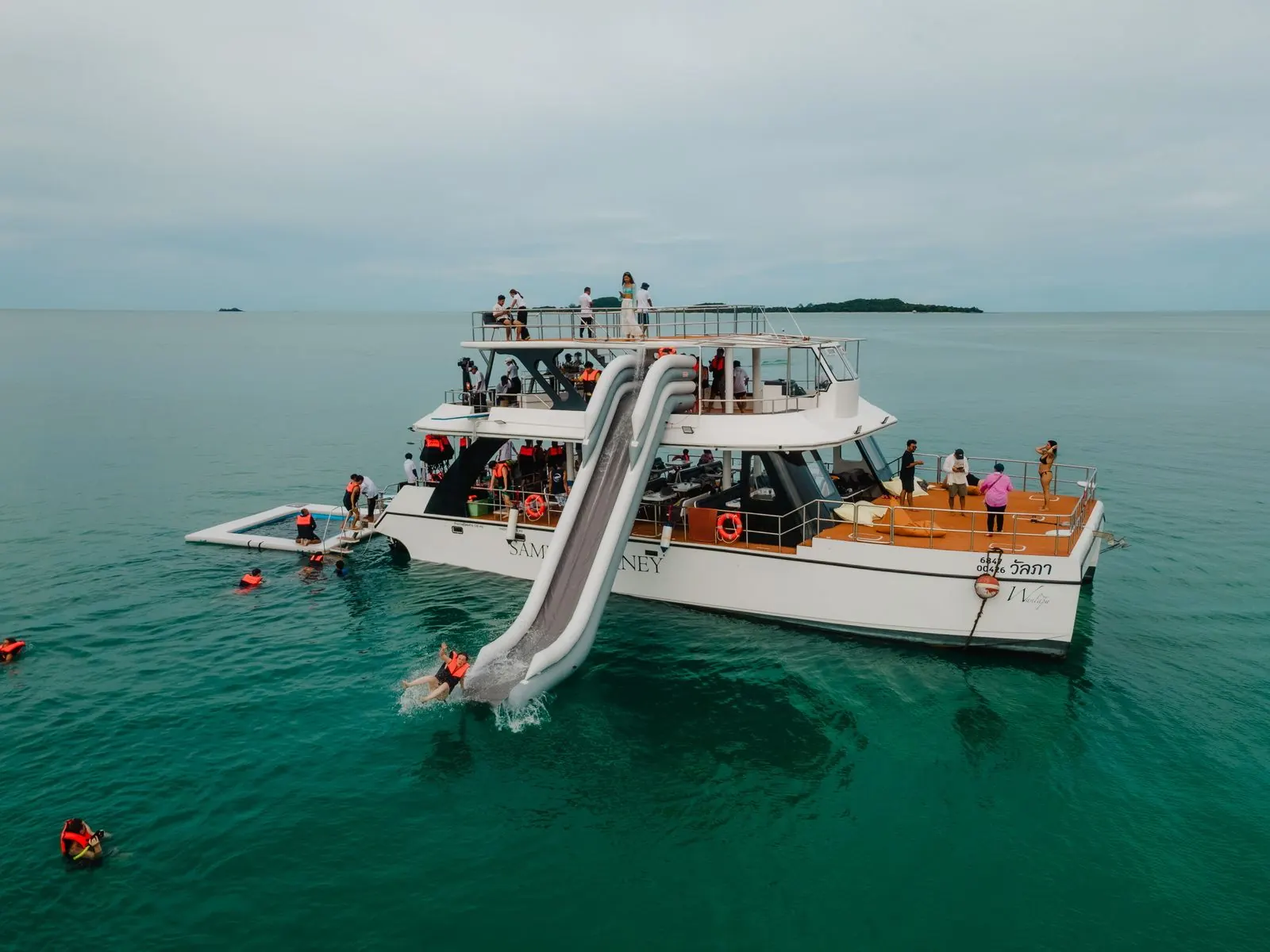
A catamaran is no guarantee either. In a big swell, any boat moves. The difference is that a wide, two-hulled boat at a steadier speed usually rides more gently, and you are free to find the most comfortable spot on board.
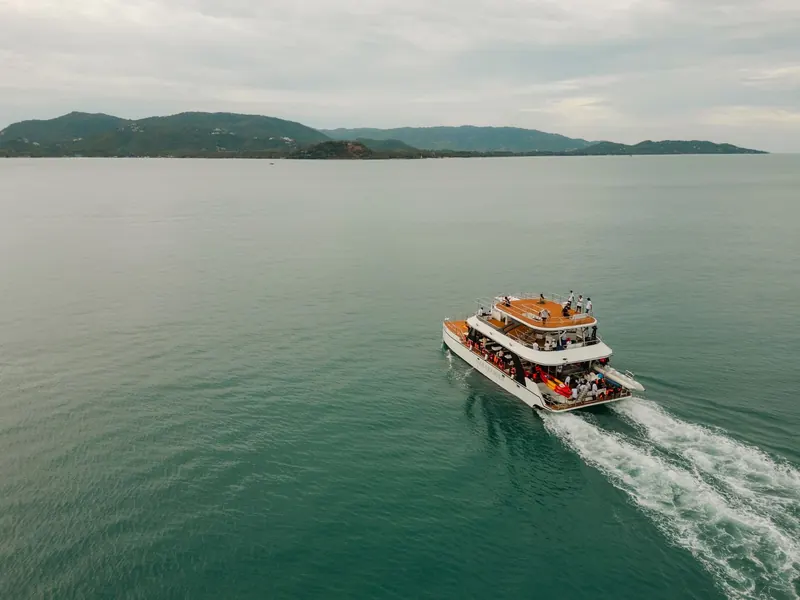
The route matters as much as the boat
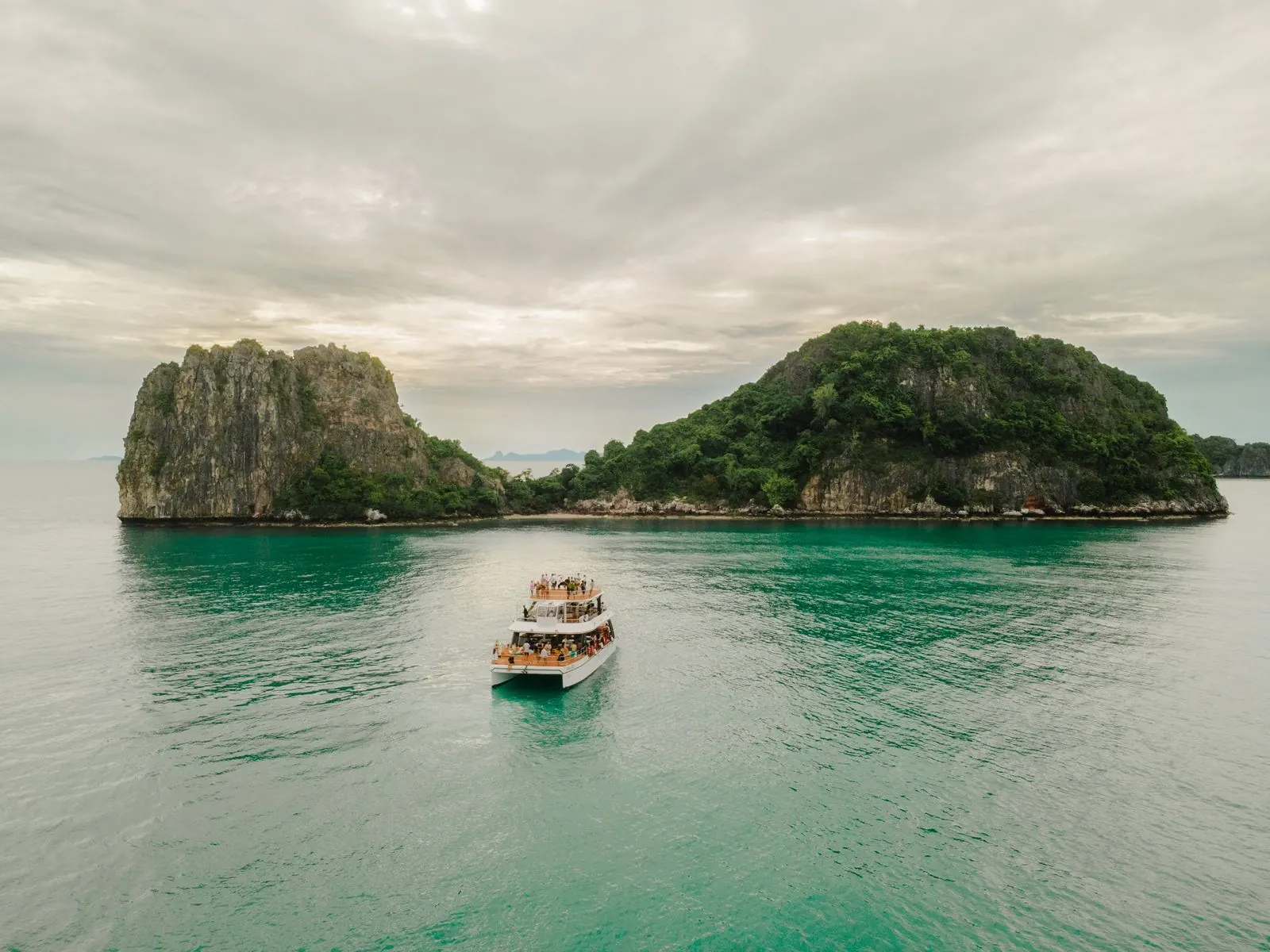
A day around the islands off Samui’s south coast (the Five Islands, Koh Tan and Pig Island) is a string of short hops close to shore. Ang Thong National Marine Park trips mean a longer open-water crossing each way, which gives choppy water more time to get to you. Our Ang Thong or Pig Island comparison goes through the two days side by side.
Time at anchor helps too. On a day built around swim stops, a good part of the trip is spent in the water or on a boat that is not moving.
The season matters most of all
Around Koh Samui the sea is usually calmest from about February to April. From mid-October to December the north-east monsoon blows across the Gulf of Thailand, and some days are too rough for comfort, or for safety. If you get seasick and your dates are flexible, put your boat day in the calmer months. Our month-by-month weather guide shows what to expect.
In any month, operators should not sail when it is unsafe. On the Samui Journey catamaran, bad weather means your trip moves to a new date first, and you get a full refund if the new date is also affected.
Before you board
- Get a good night’s sleep. Tiredness makes motion sickness worse.
- Eat lightly. The NHS advises against heavy meals, spicy food and alcohol shortly before or during travel.
- Skip alcohol the night before and on the way out. The NHS and the CDC both name alcohol as something that makes symptoms worse.
- See a pharmacist beforehand. They can suggest tablets, patches or acupressure bands, though the NHS says these do not work for everyone. The CDC advises taking medicine before you travel, not after symptoms start. Ask how far ahead to take it, and about side effects such as drowsiness, which matter if you plan to swim.
- Try ginger. The NHS mentions ginger, as biscuits, tea or supplements, as something some people find helps.
On board: where to sit to avoid seasickness on a boat trip
- Sit in the middle of the boat. The NHS recommends the middle of a boat, and the CDC advises keeping away from the spots that move most, such as the bow.
- Look at the horizon or a fixed point on land.
- Get fresh air. Stay on an open, shaded part of the deck, not in an enclosed space.
- Put the phone away. Reading, scrolling and watching moving things all make it worse.
- Keep your head still and breathe slowly and evenly.
- Tell the crew. They can point you to the steadiest spot and keep an eye on you.
If you start to feel unwell, sip water, rest in the shade and fix your eyes on the horizon. Some people feel better as soon as the boat is at anchor.
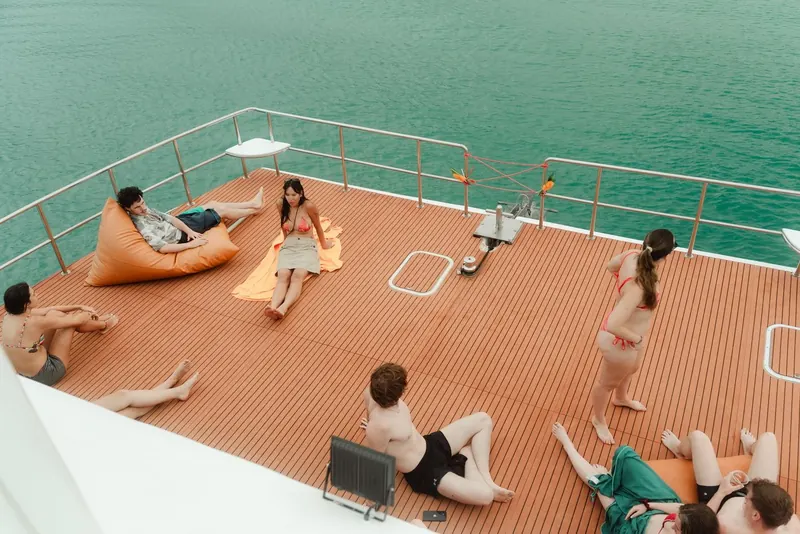
Children and seasickness
The CDC says children under two rarely get motion sickness, while school-age children are the most susceptible group. Some medicines are not suitable for children, so always check with a pharmacist or doctor before giving a child anything. Distraction helps, and the NHS suggests talking, singing or listening to music. For more on planning a boat day with children, see our Koh Samui with kids guide.
If seasickness rules out a Koh Samui boat trip altogether
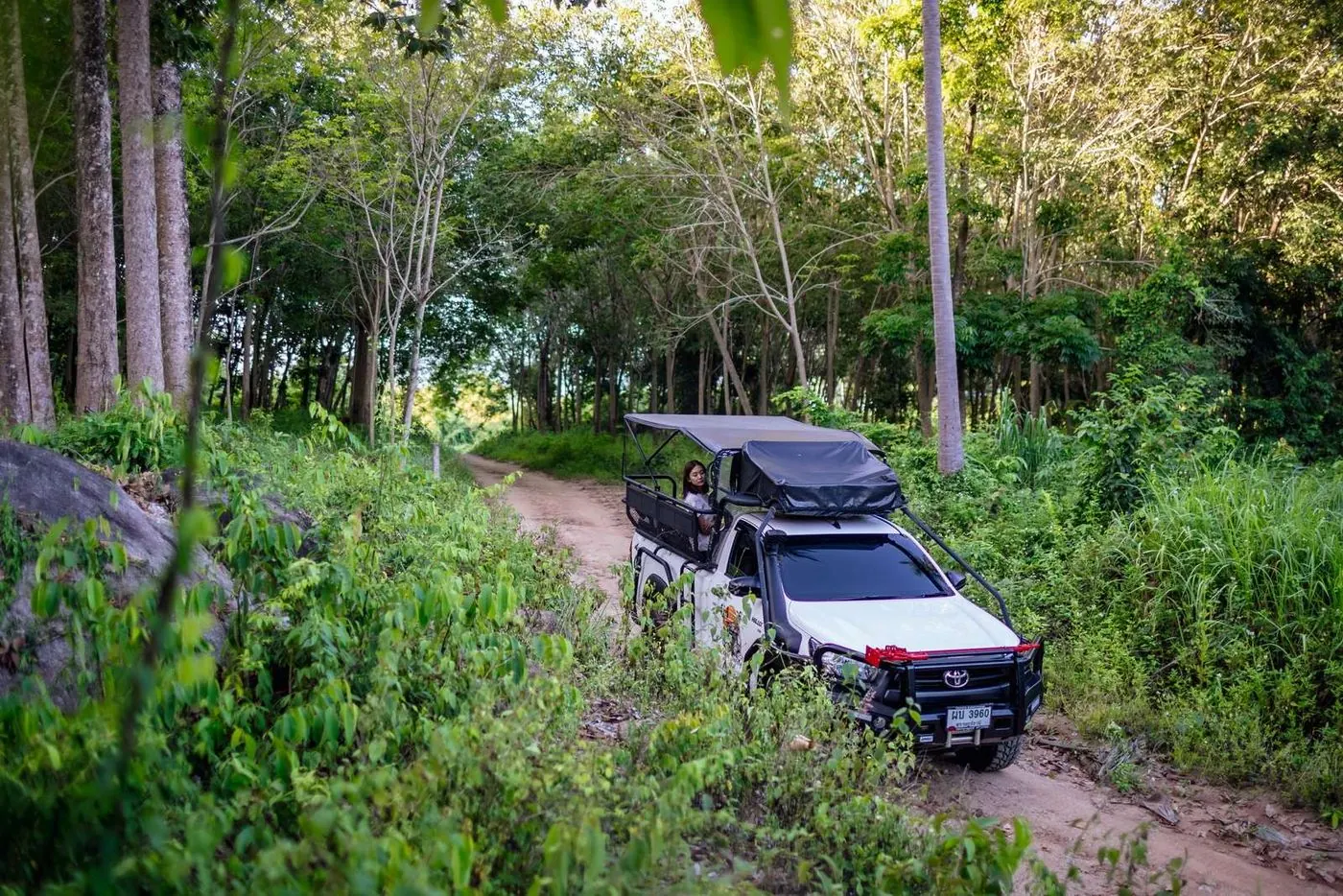
Some people know from experience that any boat is a bad idea, and that is fine. There is a lot to do on land. The Explore the Real Samui 4×4 Island Safari costs from ฿1,950 per adult (฿1,650 for children aged 5–11, under-5s free). Samui Elephant Kingdom, an ethical sanctuary that Samui Journey supports, costs ฿3,000 per adult and ฿1,700 per child aged 5–11, with under-5s free.
About the Samui Journey catamaran
If you want to try a gentler boat day, the Samui Journey 1-Day Catamaran links the Five Islands, Koh Tan and Pig Island from Bang Kao Pier on the south coast. Hotel pickup is between about 9:00 and 9:40 AM depending on your hotel area, and you are back at your hotel around 4:30 PM. Lunch, drinks, accident insurance and hotel transfers are included, there is a first-aid kit on board, and the licensed captain has more than 10 years’ experience. Cancellation is free up to 24 hours before pickup. Later cancellations and no-shows are non-refundable.
Not sure it is for you? Send us your dates on WhatsApp and we will give you a straight answer on how the sea is looking. Our boat day packing checklist also covers what to bring if you are prone to seasickness.
A steadier way to see the islands.
Short hops between the Five Islands, Koh Tan and Pig Island, with lunch, drinks, accident insurance and hotel transfers included. Adults ฿3,300, children (5–11) ฿1,900, under-5s free. See the 1-Day Catamaran or ask about sea conditions on WhatsApp at +66 94 751 4988.
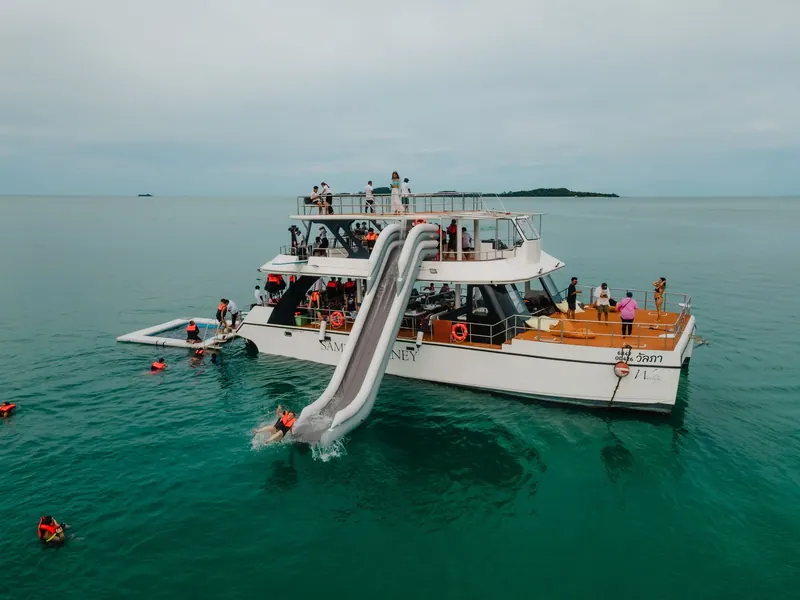
FAQ
Is a catamaran better than a speedboat for seasickness?
Generally, yes. Two hulls give a catamaran a wider, steadier base, and it travels at a gentler pace. In rough seas any boat moves, though, so the season and the route matter too.
Where should I sit on a boat to avoid seasickness?
In the middle of the boat, with a view of the horizon and fresh air. Stay away from the bow (the front), where the motion is greatest.
Which month has the calmest sea in Koh Samui?
February to April is usually the calmest stretch. November tends to be the roughest.
Should I take seasickness tablets before a boat trip?
Ask a pharmacist or doctor first. If a medicine suits you, it generally works best taken before you board, not once you start to feel ill.
Can children take seasickness medicine?
Some medicines are not suitable for children. Always check with a pharmacist or doctor before giving a child any remedy.
Does drinking alcohol make seasickness worse?
Yes. The NHS and the CDC both list alcohol as something that can make motion sickness worse.

 Islands & boats