

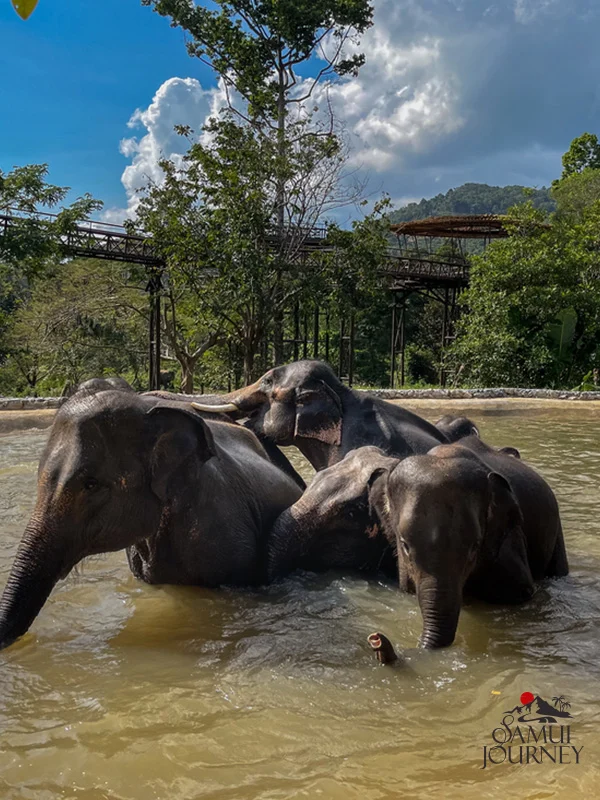
Seeing an elephant up close is high on a lot of Koh Samui wish lists. The problem is that almost every venue in Thailand now calls itself a “sanctuary”, a “rescue” or “ethical”. None of those labels is regulated, so they tell you very little about how the animals live from day to day.
Below is what animal-welfare organisations say a responsible elephant visit looks like, the red flags that should send you elsewhere, and what to ask before you pay. We also check Samui Elephant Kingdom, an ethical elephant sanctuary we proudly support, against the same criteria.
Disclosure: Samui Journey supports Samui Elephant Kingdom and books visits there. We hold it to the same checklist as any other sanctuary.
Quick facts: choosing an ethical elephant sanctuary on Koh Samui
| Topic | What to know |
|---|---|
| Strongest welfare standard | Observation only: you watch elephants behave naturally and don’t touch them (World Animal Protection) |
| Clear red flags | Riding, shows or painting, bathing with tourists, baby elephants offered for photos, elephants chained during the day |
| Grey area | Feeding. ABTA says it’s acceptable only with a barrier between you and the elephant. World Animal Protection treats it as a transitional practice |
| Scale of the issue | World Animal Protection assessed 2,849 elephants at 236 Thai tourism venues in 2024–25, and nearly two-thirds lived in poor conditions |
| Typical Samui format | Half-day visits of around 3 hours, usually with hotel pickup |
| The sanctuary we support | Samui Elephant Kingdom, with no riding and no bathing. Visitors feed from a raised Skywalk |
Why the word “sanctuary” isn’t enough
World Animal Protection (WAP) has studied Thailand’s elephant tourism for about 15 years. Its January 2026 report, Bred to Entertain, assessed 2,849 elephants at 236 venues between February 2024 and January 2025. Nearly two-thirds were living in poor conditions. Only 7.3% were at observation-only venues, though that share was growing.
There is a twist travellers should know about. Riding has fallen sharply as a share of venues, but more than half of Thailand’s captive elephants were at venues offering “washing” or “care” activities. A lot of visitors now skip riding and book bathing instead, thinking it is the kind option. WAP’s tourist guide points out that a venue can call itself a sanctuary, rescue centre or retirement home without having higher welfare standards.
ABTA, the UK travel association, came to much the same view. Its 2019 animal-welfare guidelines class elephant riding, bathing and shows as unacceptable, along with direct contact or feeding unless there is a barrier.
So judge a venue by what it lets visitors do, not by what it calls itself.
What a responsible elephant experience looks like
You watch more than you touch
WAP’s simplest rule is “look, don’t touch”. Before tourists can safely ride, bathe or hug an elephant, the animal has to be trained to put up with close human contact, and WAP’s research links that training to punishment-based methods. A good venue is laid out so you watch elephants from a respectful distance.
Elephants have space, company and choice
Wild elephants walk long distances, forage for much of the day and live in social groups. In captivity, look for:
- large, varied areas with vegetation, water and mud
- elephants that are free to move away from visitors
- animals kept with companions rather than alone
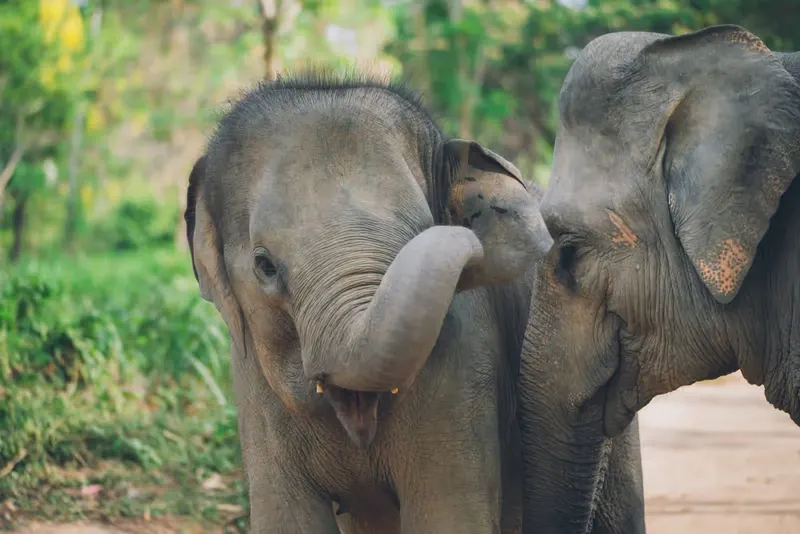
- natural behaviour such as dust-bathing, wallowing, foraging and socialising
Mahouts keep their distance
Mahouts (elephant keepers) are part of elephant care in Thailand. In WAP’s guidance, good practice means the mahout stays with the elephant for safety but at a distance. Hooks should not come out except in a real emergency.
The visit teaches you something
Better venues use visitor time to teach. Expect to hear where the elephants came from, what they eat and how they communicate. You should leave knowing more about elephants, and with more than a selfie.
Red flags: when to walk away
If you spot any of these on a website, in a review photo or on the day, book somewhere else:
- Riding of any kind, including bareback “mahout training” rides
- Shows such as painting, football, dancing, tricks or “elephant talent” performances
- Bathing or scrubbing elephants in a river or pool alongside tourists
- Baby elephants offered for photos or play. WAP warns that a calf you can see or touch, especially without its mother, means the venue is not elephant-friendly.
- Chains or very short tethers on elephants during visiting hours
- Bullhooks carried openly and used to move elephants around
- Crowded close-contact photo sessions with elephants posed next to tourists
- Vague history. If staff can’t say where an elephant came from, ask why.
The feeding question
Feeding causes the most confusion, and the guidance does not all agree.
- ABTA’s 2019 guidelines class feeding elephants as unacceptable unless there is a barrier between visitors and the animal.
- World Animal Protection’s current guide goes further. It treats hand-feeding over barriers as a transitional practice, and some venues it supports are phasing it out altogether.
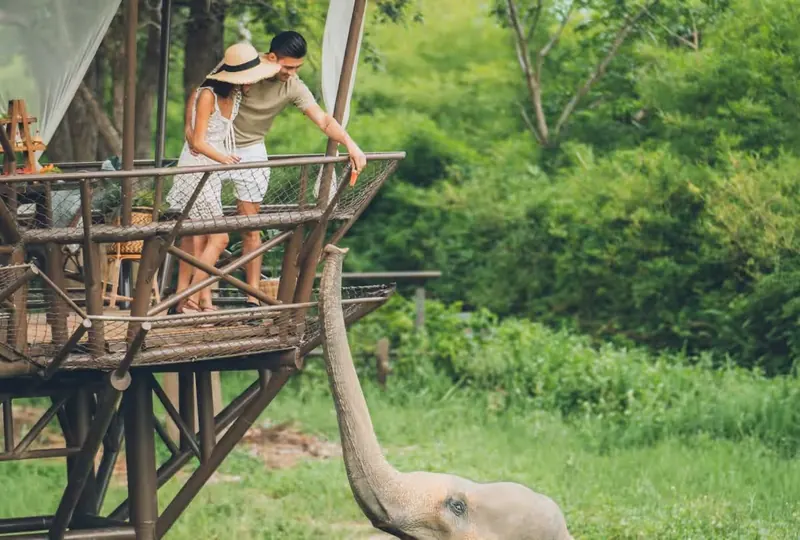
Feeding from a raised platform or across a fence therefore sits within ABTA’s guidance, but it falls short of the strictest observation-only standard. If you want no contact at all, pick an observation-only venue. If you do feed, keep to a few habits:
- feed only from behind the barrier or platform the venue provides
- let the elephant come to you, and don’t hold food back to make it reach
- give only the food the venue gives you
- don’t touch the trunk or face, however close the elephant comes
Questions to ask before you book
Send these to any operator by email or WhatsApp. A reputable one will give you straight answers.
- Is any riding, bathing or performance offered at the venue, even as an add-on?
- Can visitors touch the elephants? If so, when and how?
- Where did the elephants come from, and are any being bred?
- Are elephants chained or tethered during visiting hours?
- How many visitors are in a group, and how long do guests spend near the elephants?
- How much of the day do the elephants spend free to roam, forage and socialise?
Treat vague answers to questions 1 to 3 as a warning sign.
How Samui Elephant Kingdom measures up
Samui Journey supports Samui Elephant Kingdom and books visits of about 3 hours there, with hotel pickup. This is what the sanctuary publishes about itself, checked against the same criteria.
- No riding, no bathing. The FAQ on the official website asks “Can we ride or bathe with the elephants?” and answers no. It describes itself as strictly hands-off for bathing, so you watch the elephants wallow in the mud instead of joining in.
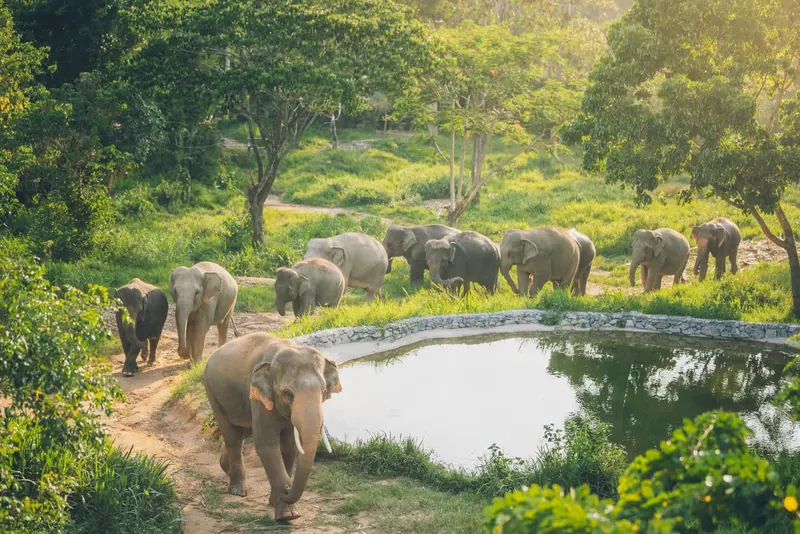
- A raised skywalk. The 400-metre walkway lets visitors watch the herd forage and socialise from above. The sanctuary describes the 20-acre site as having more than 900 trees.
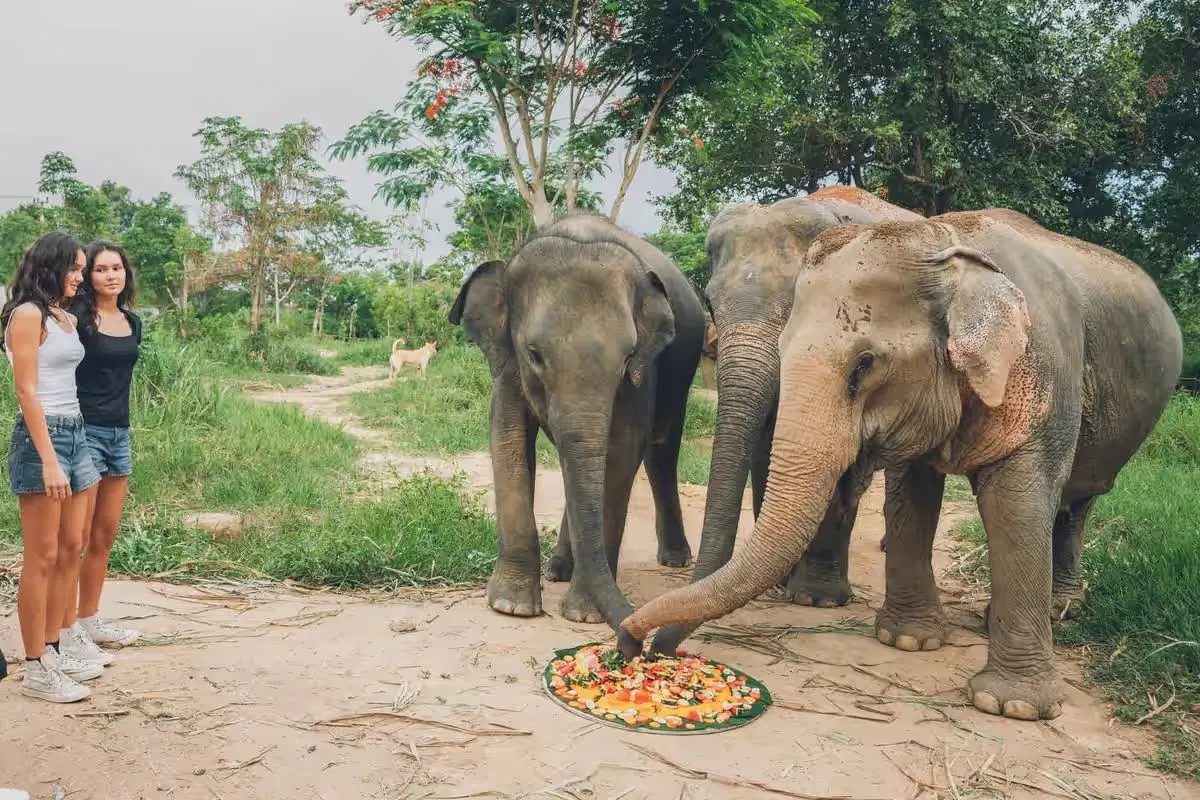
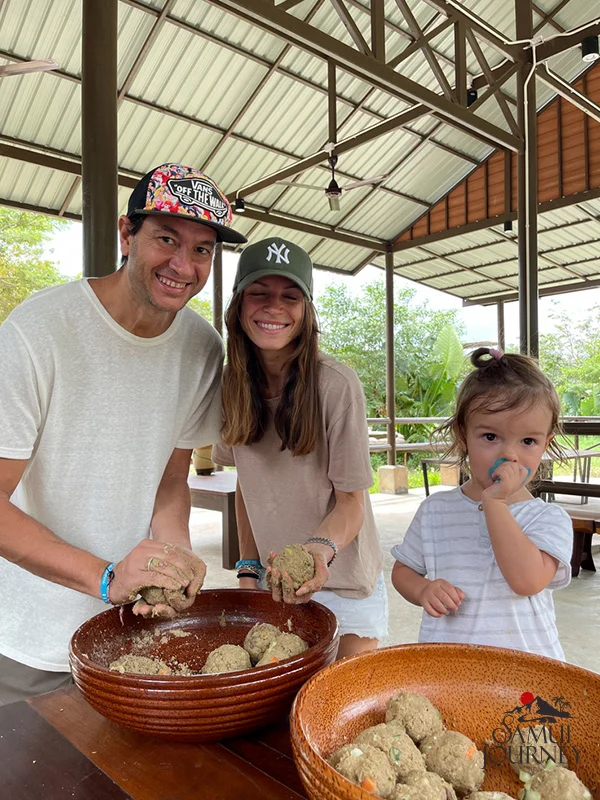
- Feeding happens from a distance. Visitors feed elephants from the skywalk and prepare “Powerball” food balls. Under the guidance above, that counts as barrier feeding, not observation only.
- Background of the herd. The official “The Herd” page says the elephants came from logging, street begging, circus performances and trekking camps. Some were born on Koh Samui or at the sanctuary.
We don’t give a head count here because the number can change. Check the official site for the latest, or ask us. For a step-by-step account of the visit, read our guide to what to expect at Samui Elephant Kingdom.
Visit Samui Elephant Kingdom with Samui Journey
About 3 hours at the sanctuary we support, morning or afternoon. Includes hotel transfers, an English and Chinese-speaking guide, a welcome, a session on what elephants eat, making “Powerball” food, feeding from the Skywalk, an observation walk at the mud pit, and lunch with soft drinks. Adult ฿3,000 · Child (5–11) ฿1,700 · Under 5 free. See the trip details · Book online
Being a good guest on the day
How visitors behave affects the animals, even at a well-run sanctuary.
- Keep your voice down and avoid sudden movements near the elephants.
- No flash photography at close range.
- Stand where the guide tells you. Elephants are big and can be unpredictable, as the sanctuary’s own terms point out.
- Don’t bring snacks for the elephants. Their diet is managed.
- Leave drones at the hotel.
- Keep children with an adult the whole time, especially on raised walkways.
Good to know
- No standard is perfect. Any captive setting is a compromise. Venues that let elephants behave naturally and keep tourist contact to a minimum are the better choice.
- Check photos, not slogans. Recent visitor photos on review sites often show what goes on behind the marketing, such as riding saddles, bathing sessions or crowds around a calf.
- Prices vary widely. A very cheap “sanctuary” ticket can mean a high-volume operation. A high price doesn’t guarantee good welfare either.
- Book with a licensed operator. Samui Journey Co., Ltd. holds TAT licence No. 44/00252. You can reach us on WhatsApp at +66 94 751 4988 or by email at samuijourney.mk@gmail.com.
- Rainy season. Koh Samui’s heaviest rain usually falls from around mid-October to early December. If you visit then, pack a light rain jacket.
Plan a hands-off elephant morning
For a visit with no riding and no bathing, our Samui Elephant Kingdom trip includes hotel pickup, a guide and time on the 400 m skywalk. Questions before you book? Message us on WhatsApp at +66 94 751 4988. View Samui Elephant Kingdom
FAQ
Is there an ethical elephant sanctuary on Koh Samui?
Yes, there are venues on Koh Samui that offer no riding or bathing. Samui Elephant Kingdom, an ethical elephant sanctuary we proudly support, states on its official website that it allows neither. “Ethical” is not a certified label, though, so use the checklist above to judge any venue yourself.
Is elephant bathing ethical?
No, according to both World Animal Protection and ABTA. Bathing requires elephants to accept close human contact, which WAP links to harsh training. WAP has also reported serious injuries to tourists during bathing sessions in Thailand.
Is feeding elephants ethical?
It’s a grey area. ABTA accepts feeding only when there is a barrier between you and the elephant. World Animal Protection treats barrier feeding as a transitional practice and prefers observation only. If you feed, do it from a platform or fence and let the elephant choose to approach.
Can you ride elephants on Koh Samui?
Yes, some venues on the island still offer rides. Welfare organisations advise against it, and Samui Journey does not sell elephant riding.
How long does an elephant sanctuary visit take?
Usually half a day. Our Samui Elephant Kingdom visit lasts about 3 hours, with morning and afternoon options and hotel pickup.
Are elephant sanctuaries safe for children?
A hands-off venue, where you watch from walkways or behind barriers, carries much less risk than one offering bathing or riding. Children should stay close to an adult, and families should follow staff instructions throughout.
 Elephants & families
 Elephants & families